
Brightness alone cannot determine whether a work light is suitable for a Class I Division 1 location. Engineers may need illumination around processing equipment, maintenance points, inspection areas, or other locations where flammable gases or vapors are a concern. Before specifying explosion proof led work lights, we need to identify the hazardous location, required approvals, temperature conditions, installation arrangement, and actual lighting task.
For industrial buyers, this means the selection process should start with site data. Wattage and fixture dimensions can be reviewed later. When the hazardous conditions are defined first, engineering and procurement teams can compare lighting documentation against specific project requirements instead of relying on a general explosion-proof description.
Start With the Area Classification
Class I locations relate to areas where flammable gases or vapors may be present. Division 1 describes conditions where ignitable concentrations may exist under normal operating conditions or can frequently occur during repair, maintenance, or leakage.
This classification affects the electrical equipment specified for the location. An industrial LED fixture should not be considered suitable simply because it has a robust enclosure or appears well sealed. Hazardous-location equipment involves specific protection concepts and approval requirements.
We recommend recording the area classification for each lighting point before product selection begins. Facilities may contain several classified and non-classified areas, so a location-based lighting schedule can reduce confusion during specification and purchasing.
Certification Must Match Project Requirements
Certification is one of the main documents we examine when evaluating hazardous-area lighting. Project teams should identify which standards and approval systems apply to the installation before comparing fixtures.
Product markings should then be reviewed carefully. They contain information about the protection concept and the hazardous conditions covered by the certification. Engineers need to compare this information with the project specification rather than relying only on product names.
When evaluating explosion proof lighting class 1 division 1, buyers should also recognize that hazardous-location classification and certification systems differ between markets. Class and Division terminology should not automatically be treated as equivalent to ATEX or IECEx zone classifications. Applicable codes, certificates, and project requirements need separate verification.
Temperature Requirements Cannot Be Ignored
Hazardous substances have different ignition characteristics, which makes equipment temperature information important. The temperature classification of a proposed fixture needs to be reviewed against the substances and conditions identified for the installation.
Ambient conditions also matter. Process areas may experience heat from nearby machinery, enclosed spaces, or environmental exposure. The permitted operating conditions stated in the product documentation should therefore be checked during fixture evaluation.
We consider temperature information together with area classification and certification. Looking at these factors as one group makes the technical review more organized and prevents lighting performance from becoming the only selection criterion.
Lighting Should Fit the Actual Work
After hazardous-location requirements have been identified, engineers can examine illumination needs. Different tasks may require different lighting arrangements. Inspection work, equipment servicing, movement around machinery, and routine operation do not always place light in the same area.
Fixture position is especially important around pipes, tanks, structural members, and large machines. These objects can block light and create shadows over working surfaces. Reviewing the intended mounting position helps teams understand where illumination is actually needed.
For explosion proof led work lights, we suggest considering viewing direction, mounting location, work distance, maintenance access, and the area that needs illumination. These practical details connect the lighting specification with the tasks carried out at the site.
Product Markings Need Technical Review
Once the project conditions have been established, a specific fixture can be compared with them. This sequence keeps product selection tied to technical requirements rather than choosing a model first and trying to fit it into the application later.
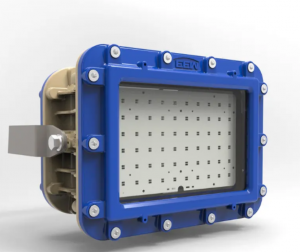
Our ELL601 Series Explosion-proof LED Lighting from Sunleem EEW has the Ex marking Ex db IIB+H2 T6/T5 Gb and Ex tb IIIC T80℃/T95℃ Db. These markings provide information for engineers evaluating the product against the hazardous-area conditions specified for a project.
The series also has ATEx Certificate No. AÜV 19 ATEX 8446X and IECEx Certificate No. IECEx TUR 19.0066X. These certification details should be reviewed within their applicable systems. They should not be interpreted as Class I Division 1 approval without corresponding documentation.
Installation Details Affect the Decision
Physical installation conditions should be reviewed before the lighting schedule is finalized. Available mounting space, fixture orientation, cable routing, and access for inspection can all influence whether a proposed lighting arrangement is practical.
Environmental exposure should be documented as well. Dust, moisture, vibration, outdoor conditions, and nearby industrial processes may introduce additional requirements. Engineers can compare these conditions with the relevant product documentation during technical review.
We also recommend considering the electrical connection together with the fixture. Cable entries and associated components form part of the installation, so their specifications should correspond with the project requirements and the selected lighting equipment.
Build a Clear Lighting Specification
A useful lighting schedule can record the area classification, hazardous substance, required certification, temperature requirements, mounting position, lighting task, environmental conditions, and electrical connection information for each location.
For projects involving explosion proof lighting class 1 division 1, the required Class and Division documentation should be verified directly. If a proposed fixture carries another certification system, engineers need to determine whether additional or different approvals are required for that project.
This documentation also helps during later maintenance. When a fixture requires inspection or replacement, teams can return to the original site requirements instead of selecting a replacement only by appearance, wattage, or physical dimensions.
Match the Light to the Location
Class I Division 1 lighting decisions should begin at the installation site, not in a product catalog. Area classification, applicable certification, temperature requirements, work tasks, mounting conditions, and electrical connections all need to be identified before a fixture is specified.
At Sunleem EEW, we use these project details when discussing hazardous-area lighting with industrial customers. A clear specification allows each proposed light to be checked against its intended location. When certification systems differ, that difference also needs to remain visible during the review rather than being treated as an automatic equivalence.
Post time: Nov-20-2026


