
Hazardous industrial environments cannot rely on a single luminaire profile to illuminate every processing unit, storage tank, and catwalk. Volatile hydrocarbons, combustible powders, and corrosive vapours demand dedicated physical architectures that simultaneously contain ignition sources and satisfy rigid photometric layouts.
Navigating the modern categories of led explosion proof lighting requires evaluating how housing geometry, optical spreads, and flamepath engineering match the physical constraints of each classified zone.
Specifying engineers frequently encounter failures when treating hazardous fixtures as generic replacements for standard commercial fittings. Each luminaire category utilizes distinct heat-sink fins, entry ports, and explosion containment methods designed around specific spatial boundaries.
Understanding these physical variations guarantees plant safety, simplifies maintenance schedules, and eliminates non-compliant lighting layouts across refinery and processing complexes.
High-Bay and Pendant Luminaires for Volumetric Plant Spaces
Heavy processing halls, distillation facilities, and warehouse storage bays demand high-lumen output from elevated mounting positions between five and twenty metres. High-bay and pendant fixtures solve this requirement through compact, circular enclosures engineered with massive external heatsinks that conduct thermal energy away from sealed diode clusters.
Solid-cast copper-free aluminium bodies isolate internal electronic arcs behind tempered borosilicate glass lenses capable of withstanding severe mechanical impacts and rapid thermal shocks.
Our engineering team at Sunleem EEW optimizes these bay luminaires with dual-compartment isolation, separating drivers from LED arrays to restrict internal heat accumulation.
In flameproof luminaires, certified flamepaths are designed to prevent an internal explosion from igniting the surrounding atmosphere. Their dimensions, clearances, and surface conditions must comply with the applicable certification requirements. Buyers should verify the protection concept of each model rather than assuming that all high-bay or pendant luminaires use threaded flameproof joints. Wide-angle conical reflectors provide symmetrical light footprints that eliminate harsh shadows across complex pipeline matrices below.
Linear Enclosures for Low-Clearance Racks and Walkways
Confined processing corridors, offshore drilling modules, and exterior pipe bridges present spatial restrictions that render high-bay housings impractical. Linear hazardous fixtures address these narrow geometries by distributing lumen output along elongated cylindrical or rectangular profiles.
Slender housings distribute uniform, glare-free light across horizontal walkways without creating dangerous blinding spots for plant personnel traversing elevated staging platforms.
Modern linear designs incorporate composite protection approaches, blending flameproof terminal bodies with encapsulated LED strips and increased-safety enclosures.
Linear explosion-proof luminaires are available in different enclosure materials and protection configurations. Buyers should compare the specified housing material, surface treatment, ingress protection rating, and corrosion-resistance information against the installation environment. For offshore or chemical-processing sites, verify the manufacturer’s documented suitability for the expected exposure conditions. Interlocking safety switches automatically cut internal power when technicians open maintenance diffusers, preventing accidental spark generation during field inspections.
Directional Area Floodlights for Target Processing and Perimeters
External tank batteries, marine loading terminals, and perimeter security fences demand concentrated, high-intensity beams directed across expansive outdoor zones. Directional explosion-proof floodlights feature heavy-duty trunnion mounting brackets that allow multi-axis targeting toward specific valves, fractional columns, or structural towers.
Specialized optical silicone lenses shape light streams into narrow, medium, or asymmetrical distributions to maximize forward lux levels while controlling light pollution.
Severe exterior environments require enclosures that combine robust explosion proofing with IP66 or IP67 ingress barriers against driving monsoons and abrasive dust storms.
We manufacture Sunleem EEW floodlighting systems with isolated driver chambers and finned aerodynamic cooling channels that maintain stable junction temperatures beneath scorching desert or humid coastal climates. Vibration-resistant hardware keeps optical focus locked onto critical target machinery despite nearby reciprocating compressors and turbines.
Autonomous Emergency and Exit Guidance Luminaires
Sudden power interruptions within chemical handling or gaseous storage areas introduce immediate risks of panic, blinded navigation, and unmonitored equipment failure.
Emergency explosion-proof luminaires provide backup illumination during power interruptions, but battery type, emergency duration, and changeover time vary by model. Buyers should verify these specifications in the product datasheet and confirm that the selected unit meets the site’s emergency-lighting requirements and hazardous-area certification conditions.
Flameproof exit indicators utilize precision-machined threaded pathways and explosion-suppressing internal barriers to isolate battery discharge cycles and charging modules from external gas pockets.
Advanced monitoring circuits run self-diagnostic test cycles, signaling battery health via external viewing LEDs to avoid unsealing the housing in classified air. Integrating durable led explosion proof lighting across emergency escape routes guarantees fail-safe orientation during critical plant shutdowns.
System Integration via Protective Electrical Fittings
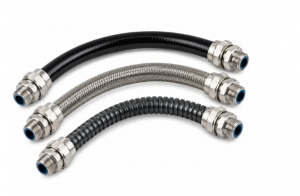
Certified luminaire housings cannot protect a facility if field cabling compromises the structural envelope at entry interfaces. Safe installation demands certified explosion proof electrical fittings, including flameproof cable glands, sealing fittings, and hazardous-area conduit unions that block gas migration through electrical pathways.
Every cable entry must comply with the luminaire’s certified construction and applicable installation standards. Depending on the protection concept and cable arrangement, the installation may require certified cable glands, conduit seals, or other approved entry components. Buyers should verify thread compatibility, sealing requirements, and permitted accessories before installation.
Rigid conduit systems running between power feeds and fixtures rely on rugged explosion proof electrical fittings to absorb mechanical vibration and isolate localized conduit faults.
Sunleem EEW offers explosion-proof lighting and electrical installation products for hazardous-area applications. When selecting compatible fittings, buyers should verify the thread type, material compatibility, protection concept, and certification requirements of the specific luminaire and accessory. Unauthorized modifications or incompatible components may compromise the equipment’s certified protection and should be avoided.
Strategic Luminaire Selection Across Hazardous Zones
Achieving an optimized hazardous lighting design requires systematically pairing luminaire geometry with specific gas groups and autoignition temperature thresholds. High-bay units suit open distillation spaces, linear luminaires clear low overheads, directional floodlights cover vast logistical boundaries, and emergency units secure critical personnel exit corridors.
Every chosen fixture must strictly align with Zone 1, Zone 2, Zone 21, or Zone 22 designations without exceeding the maximum surface temperature rating of surrounding airborne hazards.
Careful evaluation of optical requirements, thermal dissipation pathways, and structural ingress ratings ensures long-term operational safety across aggressive industrial plants.
Facility managers maximize operational uptime and protect personnel by treating every luminaire category as a precision-engineered safety barrier rather than a generic utility fixture. Proper mechanical selection, rigorous certification alignment, and sealed installation protocols create a resilient, hazardous-grade lighting infrastructure built for demanding environments.
Post time: Nov-20-2026


